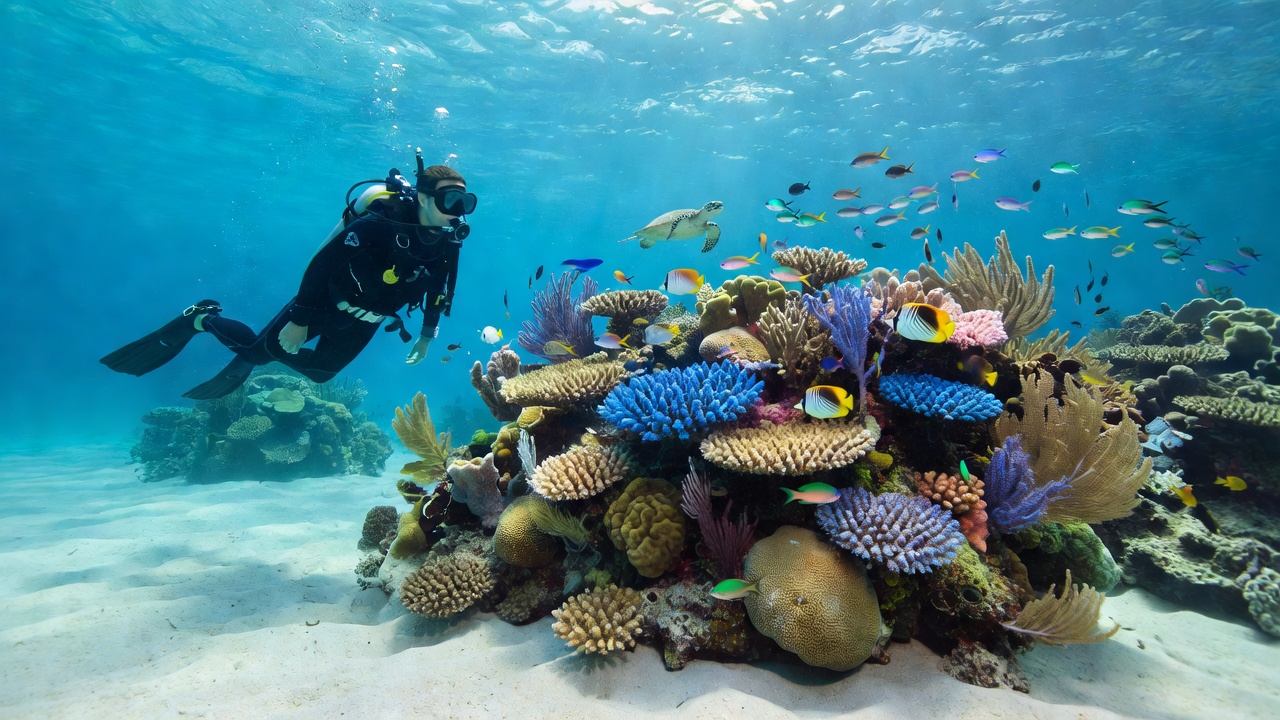
Turning Observation into a Sequence
A documentary sequence needs a truthful relationship between place, action and detail. Build it around the behaviour that occurs, not the behaviour a shot list demands.
Coverage map / sequence logic, not a prescribed animal interaction.
Research a behaviour, not just a location
Start with the question the sequence should answer. Is the audience learning how an animal feeds, how a habitat changes with a tide, or how researchers collect observations? Each question suggests different evidence. A location name and an attractive species list are not enough to decide when, where or whether filming is appropriate.
Consult local researchers, site managers and knowledgeable operators about seasonal patterns, access restrictions and disturbance risks. Places such as the Great Barrier Reef, the Galápagos Marine Reserve and Monterey Bay have different jurisdictions and ecological contexts. Permission or practice at one site does not transfer automatically to another. Confirm rules with the responsible authority for the actual activity.
Keep a research ledger that separates established facts, local reports and production hypotheses. If a behaviour is uncertain, plan to observe rather than promise it in advance. The resulting film should not present an inference as something directly witnessed by the camera.
Put operations before coverage
Underwater camera work adds task loading. The qualified dive team determines operational suitability, competence, communications and emergency arrangements. The production team supplies its image requirements so those requirements can be assessed; it does not use a shot list to override a dive plan.
In the United Kingdom, commercial diving work may fall under the Diving at Work Regulations 1997 and the relevant Health and Safety Executive guidance. Requirements depend on the operation and jurisdiction. Organisations such as the HSE, American Academy of Underwater Sciences and Divers Alert Network offer different kinds of regulatory, scientific-diving or medical information. None should be treated as an interchangeable production permit.
Agree who may call a stop, how camera problems are communicated and which filming requests require a new assessment. A missed shot is a production limitation. It is not a reason to continue an unsuitable operation.
Build coverage without manufacturing behaviour
Establish habitat and geography, observe the action, then collect details that genuinely belong to that context. A wide shot can explain the relationship between an animal and its surroundings. A closer view can reveal the action. A detail can clarify a mechanism, provided the edit does not falsely imply that unrelated moments occurred together.
Hold shots long enough to include the beginning and end of an action where conditions allow. Avoid stopping immediately after the visually dramatic instant; the aftermath may explain what happened. Repeated reframing can lose the very behaviour the camera is meant to document. Patient observation often produces more coherent coverage than constant pursuit.
Do not touch, chase, restrain, feed or reposition wildlife to obtain a response. If specialist research procedures are being documented, establish the permissions and explain the intervention accurately. The film should not conceal a controlled procedure inside an apparently undisturbed natural-history sequence.
| Coverage element | Editorial purpose | Ledger note |
|---|---|---|
| Habitat wide | Orient the viewer | Location, direction and relevant conditions |
| Behaviour hold | Show an action with context | Observed start, interruption and outcome |
| Detail | Explain a visible mechanism | Whether it belongs to the same encounter |
| Research activity | Show how evidence is collected | Procedure, permission and participant names |
Think about sound and continuity early
Hydrophones can add a distinct layer of evidence, but underwater sound collection is not automatically equivalent to camera scratch audio. Rig vibration, cable noise, boat engines and recording gain can dominate. Keep microphone, recorder, position and timing notes, and distinguish synchronised recordings from contextual sound collected separately.
Documentaries such as The Blue Planet, Blue Planet II, My Octopus Teacher and Chasing Coral are useful viewing references for different forms of marine storytelling. They are not equipment manuals. Study how scenes establish time, point of view and evidence rather than assuming that a visible image reveals the production method behind it.
Practitioners including Howard Hall and Doug Allan demonstrate the importance of specialised underwater experience. For an emerging production, the transferable lesson is not to imitate an assumed technique from a finished film. It is to work with qualified people and make the method fit the environment.
Debrief while the encounter is fresh
After the operation, record clip identifiers, subject observations, uncertain identifications and any changes to the planned method. Note discontinuities that an editor cannot infer from the footage. Sensitive wildlife locations may need restricted handling rather than inclusion in public metadata.
Review representative footage with the relevant specialist before deciding what is missing. Sometimes the next useful image is a quiet contextual shot, not a more intrusive close-up. A reliable field sequence combines evidence, restraint and enough documented context to keep the eventual edit honest.
Method note: what belongs in a behaviour log?
Record time reference, location at an appropriate sensitivity level, subject identification confidence, visible action, camera clip references and any intervention. Keep observation separate from interpretation.